

The Green Hill Farm
History


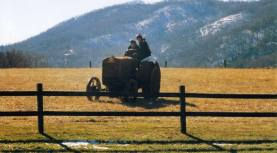
Twenty-one years ago this year, I moved to the place where I grew-up. Although Green Hill Farm in rural Virginia is a 100-year-old family farm, the main house was built around 1790, the brick cottage between 1750-1775, and the farm was referred to as Green Hill as early as the mid-1800s. My great-grandparents bought this farm in 1912 and started Green Hill Dairy Farm. My grandfather was only 2-years old when they moved here, and his sister Florence was born in the main house in 1915. My grandparents were married in December 1933, moved into the brick cottage and continued with the family farm. My dad was born upstairs in the cottage in 1940.
I spent the first part of my life in an environment of beautiful scenery, mountains, meadows, fresh air, fruit trees, vegetable gardens, farm animals and most importantly, living next door to my grandparents. I have wonderful memories of watching my Grandma Rieley make black raspberry jam, shell butter beans with the colander on her lap, and cut flowers from my great-grandmother’s lilac and sweet shrub bushes to make a lovely bouquet for me to take to my 3rd grade teacher. I remember the smell of freshly cut hay and running around barefoot in the summertime catching lightening bugs with friends. It was only after growing-up and moving away that I realized how lucky I’d been to grow up in such a place. It was this love of family and memories of my childhood that inspired me to embark on the restoration of my family homeplace. It has been and continues to be a labor of love.


There’s a sign that hangs in our vestibule or small covered porch that says “PERSEVERANCE,” and it’s been our mantra since moving to Green Hill Farm. I was in my early 30s when I decided to take on this project. Sometimes when I look back at pictures we say, “WHAT in the world was I thinking? Was I INSANE?!!” Whatever the answer, it was the path taken. This path has lead us on a journey that has been difficult and challenging at times but rewarding and enriching, too. Anyway, we all know that anything worthwhile isn’t easy. Which brings me to the next piece of our story.
The first day we visited the house after construction had started was surreal. It was a hot, humid day in June, and the grass was starting to need cutting. I could smell the fragrance of something blooming that I didn’t recognize, and the wrens were singing away–weedeater, weedeater, weedeater, tweet! As I walked toward the house and started to process what I was seeing, I felt sick to my stomach. The large, white columns that had stoically stood sentinel in front of the house had been removed from the front porch; and where they’d majestically once stood, skinny, dark, wooden poles leaned in to hold-up the roof. The porch floor had been completely ripped out, and planks lay in piles around the yard. I understood that this is what needed to happen for progress to take place, but it was still jarring. I remembered seeing Grandma sweep the floor of that porch so many times, I remembered sitting on the porch steps on Sunday afternoons listening to my aunts and uncles talk and visit as my Granddaddy rocked in the old, white rocking chair that his papa built years ago, and I remembered…I remembered all of their faces–some of them not here anymore.
I took a deep breath and thought to myself, “Chin-up! This is going to get worse before it gets better.” And I was right. I walked into what used to be the kitchen…..more rubble. It looked like the house had been hit by a bomb! I wanted to cry. As if all this wasn’t disturbing enough, in walks the project manager–I’ll call him Mack. Mack was short and stout; not so much like a teapot, but more like a barrel. He had flowing, red hair that framed a round, ruddy face. He looked kind of like a Viking. As Mack reached out to shake our hands, I noticed his charming tattoo that read, “_ _ _ _ YOU.” I’ll let you fill in the blanks. Anyway, Mack proceeded to say that he didn’t know WHAT our contractor had told us, but it certainly was going to take A LOT longer than 6 months to restore this house, and it definitely was going to cost A LOT more money, too. He beckoned us to follow him from room to room as he pointed out everything that was wrong, tired, and basically not good about the house. And after a short pause and with a frank look on his face, he said, “If I were you, I’d just bulldoze it!” A moment passed, and I thought, “What?! Did he just say what I thought he said?” I felt hot. Anger and tears began welling up inside of me. I stood there for another second, blinking back a tear, and trying to steady my voice. “We’re NOT bulldozing this house,” I quietly said. Here’s the thing: Mack wasn’t a bad guy, and he turned out to be a good carpenter. It really wasn’t his fault that he was coming across as an insensitive arse. He didn’t know about my fond childhood memories of bugging Grandma to show me the barrel vault ceilings in the upstairs bedrooms when I was little, because surely a princess would have a curved ceiling like that. Or my memory of sneaking into the house with a childhood friend via the window over the staircase that happened to be about 15 feet off the ground, using Granddaddy’s old, rickety ladder. On a more somber note, he didn’t realize that both my great-grandfather and my great uncle had both passed away within the imperfect walls of this house. Nor did he know the story of my great-grandmother sitting in the parlor, holding her nine-year-old and eldest son, Ernest in her arms as he died of meningitis, because they had barely missed the last train leaving rural Thaxton going to the City of Roanoke and a hospital. No, Mack didn’t know about ALL those memories and stories. He just saw a really old house that was at an extremely critical point. To him, it was just a dusty, dirty place with uneven floors and absolutely no right angles. He was looking at the structure of the house, but what he wasn’t seeing was its soul.


In looking back on the experience of saving my family’s homeplace, I’ve realized that not only was it a gesture of love, but more importantly, it was an act of faith. Faith, or wearing my rose-colored glasses as I like to say, sustained us through difficult times and propelled us forward. I don’t know where we would have been without it.
At the beginning of this journey shortly after my parents offered us the homeplace, my mom and I took a walk through the house. I remember walking through the dark, dimly lit downstairs hallway, the musty smell of rooms left undisturbed for too long, and cobwebs carefully covering yesterday’s treasures. I remember slowly climbing the stairs, counting each one as I went up. It made me think of Granddaddy. He once shared a story of the time his Grandmother Rieley visited when he was just a boy; She asked, “John, how many steps are there?” He quickly replied, “16!” He told me that he knew the answer because of the many, many times he had carried firewood up these very same stairs.
So, after climbing all 16 steps and arriving at the top, I began to look around. Metal and plastic buckets and maybe even a pot or two sat strategically placed to catch any drips of water. I glanced around the hallway and rooms, surveying the water-stained ceilings, peeling wallpaper, and crumbling plaster with bits of lathe peeking through. My eyes settled on an old, discolored mop-head that someone had, in a matter-of-fact manner, shoved above one of the doorways; I wasn’t exactly sure why it was there, but I didn’t dare move it. At this point, it might be the ONLY thing holding up the house! Looking around, I felt the need to sit down. As I sat on a small, antique bed covered with one of Grandma’s beloved Afghans, the sun streamed into the room and made blocks of light on the floor. I bent over with my face in my hands. I felt SO overwhelmed. Thoughts of, “I don’t know a contractor who could fix ALL THIS, and what in the world will it COST?” tripped over each other in my mind. That is, until they were steadied by my mom’s voice–”Wouldn’t it be something if y’all could save this old place? Just think of the family history.” I had not heard her come into the room. I sat up and considered. As we walked back through the water damaged rooms, down the sixteen steps and into the dark, musty, cobweb-filled hallway, I started to envision the house full of light and air with freshly painted walls and refinished floors. I could see family heirlooms lovingly placed in each of the rooms, and I could hear voices and laughter throughout the house once more. At this point, my rose-colored glasses were firmly in place for the duration.
However, the voices initially heard throughout the house were not those of my descendants, relatives, or friends, but those of the men who were working to save it. Many days ahead would be filled with trials, tears, and anticipation. There were days of workers quitting because the house was just too challenging; It was dusty, dirty, and completely without any square angles. The house was also solid brick–4 courses thick. So, trying to run wire through a house with that much brick earned it the moniker, “The House from Hell.” Of course, it didn’t help that our electrician was called Squirrel. There were also the days of getting no work done at all. And there were plenty of those, too. Change order after change order after change order was filed–27 to be exact. That’s A LOT of change orders as well as frustration and expense. I remember conversations of me asking my husband, “What do you mean we can ONLY afford patio doors but NO windows in the sunroom? How’s the sun supposed to get in?” Not only were we stressed out, but we were running out of money and patience. It was a difficult time, but underneath the strain and chaos there was a sense of what this place would mean to us, and an idea of the life that we could create.
I remember one cold, but sunny day in December when we weren’t even halfway through the restoration, and my brother-in-law visited from Atlanta. We walked through the house assessing the progress… and lack of it. At the end of the house tour, we found ourselves in the guest room upstairs that happens to have a wonderful view of our old barn. As we stood in the middle of the room–void of all plaster with only lathe showing, I motioned toward the window facing the dilapidated barn and enthusiastically announced, “That’s where I’m going to have sheep!” My brother-in-law turned toward me with a look of bewilderment on his face that quickly turned to humor, and said, “ What do you mean SHEEP!? You don’t even have walls, yet!” We both laughed. He was right! I knew he was right. Besides, I didn’t really know anything about sheep–much less where to get them. But I did have faith: faith that there would be walls, and faith that there would one day be sheep.
Here’s the thing: Toward the end of our house restoration journey there had been many days that I felt sick, tired, and fed up, but I never gave up. I never gave up, and I continued to have faith that it would all turn out well in the end. I remember after a tough year and a half, our contractor admitting, “ This has been the hardest, most difficult job I’ve ever taken on in my 25 years of building, but it’s the one of which I’m the proudest.” He was right. It was tough, but it had been worth it. Not only were we proud, but we had saved a 200 year-old home, where for almost 100 years, many of my family members had been born, lived, and died. I’d come to the opinion that most things in life are redeemable, and with enough love and faith almost anything can be transformed for the better. I had also realized that we weren’t really at the end of our journey, because the truth is…life IS the journey. And a good pair of rose-colored glasses sure do come in handy along the way!